Subluxing Peroneal Tendons
Friday, January 4, 2013
Intrasheath Subluxing Peroneal Tendons
For those going through intrasheath subluxing peroneals (where the tendons pop and snap, but they don't pop out over the bone), I found this article, and I feel that it is extremely informative! Check it out if you feel that you may have a problem, but don't think that it is a traditional tendon subluxion. The cool thing is that the surgery doesn't look as invasive as it does with the type of repair that I had. If you think that you are suffering from this, I would even print out the article and take it in to your doctor to read. It's such a rare thing that some doctors may have no idea what is wrong with your ankle. If you are able to show this information, no doubt they will be impressed, and you will have a faster road to recovery because sometimes being diagnosed is the hardest part! The link is below:
http://www.hindawi.com/crim/medicine/2013/274685
P.S. It has been 1 year since my last surgery! The surgery took place on Dec. 21st 2011. I will take a picture and post it soon so that you can see what my ankle looks like after having a year to heal!
| Reactions: |
Thursday, November 1, 2012
Surgery Q & A
One of my readers emailed me and asked the following questions about my ankle surgery! Rather than just responding to her, I thought it would be a good opportunity to share my answers here, just in case some other people out there have the same questions. If anyone reading this has any other questions, feel free to email me at emmagreenie@live.com and I will try to answer any questions you have as quickly as I can!
Q. Following your first accident did your peroneals completely sublux (i.e the superior peroneal retinaculum is torn or damaged)?
A. Yes. After my first accident, the peroneals were subluxing completely. The doctor told me that my retinaculum had been stretched beyond the point where it would heal itself naturally. So the tendons would pop clear up and over the fibula (outer ankle bone), then they would snap back into place. With my second injury, the peroneals didn't pop out quite as far as they did with the first (probably because of the way that the retinacula was fixed during the first surgery), but the popping hurt much worse with the second injury.
Q. With your surgeries (first and second) what was performed? Did the surgeon repair the retinaculum and deepen the groove (fibula)?
A. In some cases, the groove must be deepened. This usually happens when people are born with shallow grooves, and that is part of the reason that their tendons began subluxing in the first place. I consider myself very lucky because my grooves are deep enough and they did not need to be deepened by the surgeon.
I am also lucky because during both surgeries, my tendons didn't need to be repaired. Sometimes the tendons will tear, either during the initial injury, or as a result of all of the popping out as they are weakened. It's my understanding that if your groove needs to be deepened, and/or the tendons need to be repaired that the healing time may take slightly longer, and may be a bit more painful. I never had an MRI, and in both cases, the doctors decided to wait until the surgery to see if it was a groove problem, or if the tendons were damaged. Luckily, both times it was just the retinacula that needed repair.
Q. If your SPR (superior peroneal retinacula) was repaired how did the surgeon perform that part? I've seen the drilling out of fibula and making a latch to hold the SPR in place. Looks "full on" : )
A. I honestly don't know a whole lot about how the retinacula was repaired in the first surgery. (I was 18 at the time, and didn't think to question many things about it - my mom would know a whole lot more than I would). I believe that with the first surgery he cut part of the retinacula out and then stitched it back together to make it tighter.
With the second surgery, my new doctor wanted to make sure that this wouldn't happen again, so I did have the fibula drilled and I believe some of the retinacula was pulled up through it in order to keep in in place. I have heard of people having a bone block, where basically a piece of bone reinforces the opening that is covered by the retinacula, but I didn't have that. I do know though that the healing process was longer with the second surgery, and I would attribute that to the fact that my bone was drilled through. It took about 9 months before my fibula finally stopped hurting when it was touched.
Q. You were in a hard cast post second surgery for 8 - 10 weeks? Did you use a cam boot (strap in inflatable walking boot)?
A. I was actually in a hard cast after my second surgery for only 2 weeks (sorry if I said 8-10 somewhere!) I found it very interesting that the doctor put me straight into a hard cast (when I woke up from surgery it was already on). The cast was very loose and cushioned with gauze to allow for swelling, and for the first 4-5 days following the surgery, the swelling made the cast feel very tight and almost claustrophobic. However, after that period it was fine for the remaining week and a half or so. I did not put any weight on my leg while I was in the hard cast. However, every doctor is different. Bhargav, who has been sharing his recovery with us, says here that he had a hard cast that was able to bear some weight. I was fitted for a walking boot after the hard cast came off.
Q. How long before you could say walk 40-50 mins at pace for exercise?
A. After being fitted for the walking boot, I was on crutches and couldn't bear weight for another 2 weeks (see timeline below), but after I was able to bear weight on the walking boot, my mobility no longer felt restricted. I assume that this question is referring to being able to walk without the aid of a walking boot or brace, in which case it would have been about 4 months after the surgery.
Q. Sorry to ask, what about scarring?, Did you have endoscopic surgery or open surgery with an approx 10 cm cut?
A. Both of my surgeries have been open. For the second surgery, the I was cut open in the exact same spot as the first so I don't have two separate scars or anything. The scar is between 2-2.5 inches long, and it runs under my ankle bone. (You can see the pictures of it at the bottom of my previous post, here). I need to take some updated pictures of it, now that it is almost a year post surgery. The shape and length are still the same but it is not too noticeable now. It just looks kind of red and shiny. After my first surgery it did not stand out as much as it does now, but since it has been opened twice in the same spot, it's understandable that it shows more.
Here's another picture of it, immediately after the stitches were removed. It is a little more high def than the ones on the previous posts because it wasn't taken with my old cell phone.
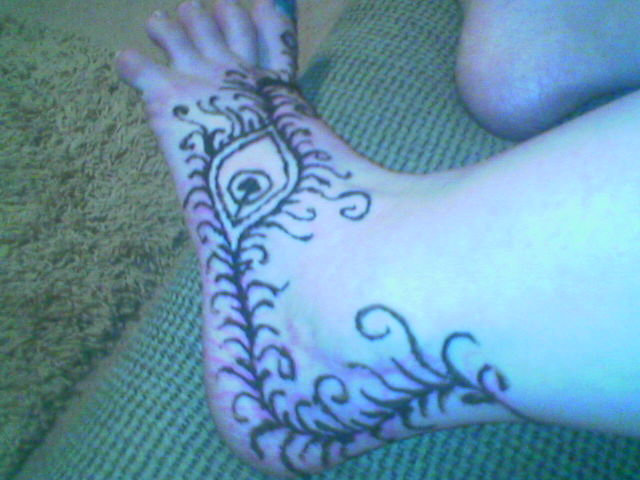
I do have a picture of my ankle after I drew a henna tattoo on that ankle, and here's a picture of it before I took the henna off. You can see the scar a little bit in this pic, and see that my ankle is a little swollen. This was about 4-5 months after the surgery.
Q. Have you been able to return to skate boarding, running?
A. Sadly, I gave up skateboarding after my first surgery. Not because I was scared of it, but just knowing that I have loose joints and that I am prone to this injury, I decided not to take that risk anymore. Plus, I never was good at skateboarding, haha. I just did it because I thought it would be cool, but in all honesty I have horrible balance and it was never one of my passions or anything. If I was good at skateboarding then I probably would have taken it back up. As far as running goes, I ran cross country in high school, but since then I haven't ever really trained for a race or anything. I really just run to stay in shape, though I don't do it as often as I should. After my first surgery, I didn't change anything about my running. I really just never thought I would re-injure my ankle. After the second surgery (considering how easily I rolled my ankle and needed the second one), I began being more careful. Even now, I am still very careful when I run, or walk on uneven surfaces. I read some treadmill reviews, and ended up getting a treadmill because for me, running on a flat and steady surface feels safer. Swimming is also great exercise and I enjoy it very much - and I don't have to worry about my ankle when I swim. I have very lightly twisted my ankle while walking since my second surgery, but it felt very stable and never hurt. So my hopes are that the second surgeon really has fixed it for good.
Here is a brief timeline of when things happened after my second surgery:
Sept. 2012 Twisted Ankle, went to instacare (who said it was only a minor sprain)
Oct. 2012 Went to ankle specialist since I recognized that my peroneals were subluxing
Nov. 2012 Met with surgeon in Northern Utah (4 hours from home)
Dec. 2012 Went in for surgery the 21st, and was put in a hard cast when surgery was complete. Was extremely sick and on bedrest the first week. (I'm allergic to pain medications, which is why I was sick). Second week was feeling a bit better, and could hobble around on crutches.
Jan. 2012 Two weeks after surgery I went to the doctor and had my hard cast removed and stitches taken out. I was fitted with a walking boot (one that used straps and an air pump to tighten). I still wasn't allowed to put weight on the walking boot for 2 more weeks.
Late Jan. 2012 One month post-surgery I was able to start putting weight on my walking boot. This was initially hard to do since I hadn't put any weight on that leg for an entire month. After getting used to it though, I felt much better.
March 2012 I didn't go to a physical therapist, though if I was going to, now would have been the time. I didn't go because I am a poor college student with horrible insurance and the surgery cleaned me out financially. Since I had gone to physical therapy after my first surgery, I began doing the exercises and using my theraband at home.
April 2012 I stopped wearing the ankle brace in early April, and because I had been doing my exercises, my ankle felt good and stable. My ankle continued to be sore to the touch and slightly swollen up to 9 months post-surgery. Now it is what I would consider to be normally sized, and it doesn't hurt. The range of motion is nearly the same as my good ankle.
I hope this has been helpful to some people! I know it is very long. If you have any other specific questions, just let me know and I will do my best to answer them!
| Reactions: |
Monday, October 29, 2012
My Ankle Injury Story (And a Couple of Ankle Pics)
Sorry I haven't been updating this blog as much as I should. For work, I began writing for proformcoupon.com so my focus has been elsewhere lately, but I really want to increase awareness of peroneal tendon subluxation! It has been almost a year since my last ankle surgery, and I'm happy to say that my ankle is doing pretty well at this point. Up until about a month ago, it was still painful to touch the outer ankle bone and the surgery area, but now it is doing much better. My husband is in Physical Therapist Assistant school right now, and he has been coming home from school lately with all of these little range of motion exercises to practice on me. Even though he only started doing them a month or two ago, I think they have really helped with the healing process. The bottom line is that this injury isn't something that you recover from overnight after your casts and braces are removed.
I received an email today asking about how I was originally injured, and I realized that I never really talked about that on this blog, so here was my response to her:
So I have gone through the surgery twice now - once about 5 years ago, and one almost a year ago. With the first occurrence, I was riding a longboard (long skateboard) on a paved trail, and I hit a rock that was sitting on the path. It caused me to fly off of the board, and it all happened very quickly. It felt like I just smacked the outer side of my left ankle on the pavement really hard. It was very painful but I just figured it was a sprain because it showed all of the characteristics of a sprain. I didn't even think much about the popping when it started because I figured it was just a temporary thing and part of the recovery process. Finally, more than a month after my injury, I went to get it checked at an instacare because I could see that it wasn't getting better. They took x-rays and such, but then just referred me to ankle specialist. The ankle specialist told me that I would need the surgery, and that was that. The recovery from the first surgery didn't seem too awful really.
I re-injured my ankle 4 years later, literally just running from my car to my front door, and I just rolled it. I was shocked, and it hurt so so badly. Worse than with the first injury (probably because it tore up everything that they had tacked down in the first surgery). I guess I am kind of prone to this injury because I have very flexible (and thus unstable) joints. The second surgery was last December, and the first week of recovery was horrible. I was extremely sick because of the medications. I was on bedrest for that first week, but even after I was off bedrest I didn't want to get up for anything. Luckily, after about the first 2 weeks, I felt much much better and I was able to return home (I had been staying at my parents house so they could take care of me). It has been almost a year since that surgery and my ankle feels good and stable. I don't regret getting either of the surgeries, though the second doctor/surgeon seemed more knowledgeable to me about the whole thing and I feel like my ankle isn't going to "come undone" again. Hope this helped a little, and if you have any specific questions, just let me know. I'm just trying to raise awareness a little because I was so frustrated when I realized that there is a serious lack of information about this injury.
If you haven't read about my most recent recovery from ankle surgery, check that out here.
And I'd just like to leave you with two cell phone pictures that my sister took right after they removed my cast at the beginning of January this year. They took off the cast 2 weeks post surgery. These were taken right after the stitches were removed (which was a very painful process!) You can faintly see the 'YES!' that I wrote on my ankle before the surgery to make sure they were operating on the correct ankle. You can also see some purple pen marks around the scar. Also, my ankle and calf are really thin because they had started to atrophy. And the last thing to take note of is my blue toenails. I had gotten a pedicure a few days before the surgery so that my toes could "look cute" in my cast. Then at the hospital they said they would have to remove the polish so that they could make sure that my toenails weren't actually turning blue after the surgery. I begged them not to take off the polish, but I was doubtful that they would listen. When I woke up from the surgery, my first question to the nurse was whether or not my toenail polish was still there. And it was! The little glimmer of happiness in my life that day :)
I received an email today asking about how I was originally injured, and I realized that I never really talked about that on this blog, so here was my response to her:
So I have gone through the surgery twice now - once about 5 years ago, and one almost a year ago. With the first occurrence, I was riding a longboard (long skateboard) on a paved trail, and I hit a rock that was sitting on the path. It caused me to fly off of the board, and it all happened very quickly. It felt like I just smacked the outer side of my left ankle on the pavement really hard. It was very painful but I just figured it was a sprain because it showed all of the characteristics of a sprain. I didn't even think much about the popping when it started because I figured it was just a temporary thing and part of the recovery process. Finally, more than a month after my injury, I went to get it checked at an instacare because I could see that it wasn't getting better. They took x-rays and such, but then just referred me to ankle specialist. The ankle specialist told me that I would need the surgery, and that was that. The recovery from the first surgery didn't seem too awful really.
I re-injured my ankle 4 years later, literally just running from my car to my front door, and I just rolled it. I was shocked, and it hurt so so badly. Worse than with the first injury (probably because it tore up everything that they had tacked down in the first surgery). I guess I am kind of prone to this injury because I have very flexible (and thus unstable) joints. The second surgery was last December, and the first week of recovery was horrible. I was extremely sick because of the medications. I was on bedrest for that first week, but even after I was off bedrest I didn't want to get up for anything. Luckily, after about the first 2 weeks, I felt much much better and I was able to return home (I had been staying at my parents house so they could take care of me). It has been almost a year since that surgery and my ankle feels good and stable. I don't regret getting either of the surgeries, though the second doctor/surgeon seemed more knowledgeable to me about the whole thing and I feel like my ankle isn't going to "come undone" again. Hope this helped a little, and if you have any specific questions, just let me know. I'm just trying to raise awareness a little because I was so frustrated when I realized that there is a serious lack of information about this injury.
If you haven't read about my most recent recovery from ankle surgery, check that out here.
And I'd just like to leave you with two cell phone pictures that my sister took right after they removed my cast at the beginning of January this year. They took off the cast 2 weeks post surgery. These were taken right after the stitches were removed (which was a very painful process!) You can faintly see the 'YES!' that I wrote on my ankle before the surgery to make sure they were operating on the correct ankle. You can also see some purple pen marks around the scar. Also, my ankle and calf are really thin because they had started to atrophy. And the last thing to take note of is my blue toenails. I had gotten a pedicure a few days before the surgery so that my toes could "look cute" in my cast. Then at the hospital they said they would have to remove the polish so that they could make sure that my toenails weren't actually turning blue after the surgery. I begged them not to take off the polish, but I was doubtful that they would listen. When I woke up from the surgery, my first question to the nurse was whether or not my toenail polish was still there. And it was! The little glimmer of happiness in my life that day :)
| Reactions: |
Monday, September 17, 2012
Recovering ankle update: Out of the cast!
Hello everyone, I got out of my cast on Friday!
I was in the cast for about 4 weeks. Once out of the cast, my foot feels all weak and wobbly. It takes some time to get adjusted to walking. I am putting most of my weight on my right foot. I have an aircast that protects my ankle from rolling until I get back my strength through exercises.
I start physical therapy tomorrow. My surgical wound seems like its almost healed (see the picture below). There was a lot of dead skin over it when they took the cast out. The ankle was also pretty stiff. My surgeon checked to see if the tendon was now stable and not subluxing. I did not have the strength to push against his hand so he applied some pressure and felt that the peroneal tendon was stable and wouldn't pop out. That is all for now, I will add in another post once I start physical therapy!
I was in the cast for about 4 weeks. Once out of the cast, my foot feels all weak and wobbly. It takes some time to get adjusted to walking. I am putting most of my weight on my right foot. I have an aircast that protects my ankle from rolling until I get back my strength through exercises.
| Aircast Airsport |
![]() |
| My ankle after coming out of the cast |
| Reactions: |
Thursday, September 6, 2012
Follow up from Brian
Hey guys, if you haven't read about Brian's P.T.S. Experience yet, check it out. In the meantime, here is a follow up that he sent to me, via email, about it. I especially love that he talked about various stretching exercises that he does in order to keep his ankle feeling nice and strong. Thanks for sharing Brian! Glad to see that you are doing so well now!
I'm glad that you want to share my story on your blog, and would be happy to help anyone out who can benefit from it. I know that when I went through this, there was no forum like this at all. One of the reasons I provided so much detail was because there's very few detailed explanations (that the normal "non-medical" patient can understand). Truth is, a lot of physicians probably don't even have a lot of experience with it because as you know it's rather uncommon. Honestly, in a way, it was very therapeutic and liberating to tell my story. I probably mentally held onto this way too long. Thank you!
Yeah, I think for a few years even after I described I would get some occasional stiffness, aches, etc. But it was almost always after doing a lot of activity (like a long jog). Compared to the uninjured ankle, it might just be "a little more sore" the next morning. But, not a big deal. The one thing that I noticed for a long time, which has improved (but maybe not fully, as I still have to be conscious to stretch every now and then), is my soleus muscles can still tighten up quite a bit. To kind of stretch it out, I will put my hands against a counter top or wall and then bend my knee while doing a calf stretch. I can usually go down quite a bit further on the good leg. Also, sometimes I will do a "deep squat" with just my own body weight and sort of "sit on the back of my ankles" for about thirty seconds. Also, I'll sit on a seated calf raise machine, put some weight on it, and just let my foot stretch out for about 30 or 40 seconds. That really stretches them out. For the most part, this "feels good" (in a normal exercise stretching kind of way). But, over the years, I've just naturally seemed to have gotten a lot of ROM back without really doing anything special.
To this day, I still run a lot, row on a crew team, and lift weights three or four days a week. My ankle never slows me down and I never think about it, or even have any concern for it. The scar, which looked horrible for the first few years, doesn't even look that bad anymore. All the feeling nerves grew back and it doesn't "feel numb or strange" anymore either. It did for several years. Even though going through the injury was awful, the after effects of it seem to be more desirable than perhaps a bad sprain or fracture (at least you don't seem to have to worry about instability, arthritis, etc. like you do with the other more "normal" ankle injuries).
It's kind of ironic that I recently sprained my other ankle doing a trail run by my house. I'm seven weeks out and seem to be recovering as planned for a Grade II ankle sprain (ATFL tear). Still some pain and stiffness after being a boot for a month, but actually "improving" (as you know how it is with the subluxation... doesn't seem to "improve" a whole lot after you reach a certain point). I went to the same surgeon. When he saw me, he said "I remember you! You were a young guy back then" (ha!), but only goes to show how much I was in his office for this particular injury. He's probably had a thousand or more patients since I last saw him. He kind of discharged me years ago and I never really followed up with him. I told him that "you fixed my problem last time" and he looked genuinely relieved. He said "I wasn't sure if I did or not" because I had the pain, etc.and never really sent him a letter or anything (I figured he was too busy). Anyway, I had him check for the subluxation and he said I was fine this time... but like anyone who has been through this surgery, I'm always paranoid about it!!!
I'm glad that you want to share my story on your blog, and would be happy to help anyone out who can benefit from it. I know that when I went through this, there was no forum like this at all. One of the reasons I provided so much detail was because there's very few detailed explanations (that the normal "non-medical" patient can understand). Truth is, a lot of physicians probably don't even have a lot of experience with it because as you know it's rather uncommon. Honestly, in a way, it was very therapeutic and liberating to tell my story. I probably mentally held onto this way too long. Thank you!
Yeah, I think for a few years even after I described I would get some occasional stiffness, aches, etc. But it was almost always after doing a lot of activity (like a long jog). Compared to the uninjured ankle, it might just be "a little more sore" the next morning. But, not a big deal. The one thing that I noticed for a long time, which has improved (but maybe not fully, as I still have to be conscious to stretch every now and then), is my soleus muscles can still tighten up quite a bit. To kind of stretch it out, I will put my hands against a counter top or wall and then bend my knee while doing a calf stretch. I can usually go down quite a bit further on the good leg. Also, sometimes I will do a "deep squat" with just my own body weight and sort of "sit on the back of my ankles" for about thirty seconds. Also, I'll sit on a seated calf raise machine, put some weight on it, and just let my foot stretch out for about 30 or 40 seconds. That really stretches them out. For the most part, this "feels good" (in a normal exercise stretching kind of way). But, over the years, I've just naturally seemed to have gotten a lot of ROM back without really doing anything special.
To this day, I still run a lot, row on a crew team, and lift weights three or four days a week. My ankle never slows me down and I never think about it, or even have any concern for it. The scar, which looked horrible for the first few years, doesn't even look that bad anymore. All the feeling nerves grew back and it doesn't "feel numb or strange" anymore either. It did for several years. Even though going through the injury was awful, the after effects of it seem to be more desirable than perhaps a bad sprain or fracture (at least you don't seem to have to worry about instability, arthritis, etc. like you do with the other more "normal" ankle injuries).
It's kind of ironic that I recently sprained my other ankle doing a trail run by my house. I'm seven weeks out and seem to be recovering as planned for a Grade II ankle sprain (ATFL tear). Still some pain and stiffness after being a boot for a month, but actually "improving" (as you know how it is with the subluxation... doesn't seem to "improve" a whole lot after you reach a certain point). I went to the same surgeon. When he saw me, he said "I remember you! You were a young guy back then" (ha!), but only goes to show how much I was in his office for this particular injury. He's probably had a thousand or more patients since I last saw him. He kind of discharged me years ago and I never really followed up with him. I told him that "you fixed my problem last time" and he looked genuinely relieved. He said "I wasn't sure if I did or not" because I had the pain, etc.and never really sent him a letter or anything (I figured he was too busy). Anyway, I had him check for the subluxation and he said I was fine this time... but like anyone who has been through this surgery, I'm always paranoid about it!!!
| Reactions: |
Thursday, August 30, 2012
Brian's P.T.S. Experience
I have been in contact with a man named Brian who went through the surgery and recovery process about 10 years ago. There was very little information available about subluxing peroneal tendons at the time, and Brian had a very rough recovery. Here is his story:
I had this surgery performed on me 10 years ago.
I sprained my ankle in February 2001 and it just never seemed to heal. I was, and still am to this day, an athletic person (to give you an indication of my general fitness and level of activity at the time of injury and recovery). I was 28 at the time.
I sprained it while hiking. I slipped on a rock, fell on my butt first, and both my feet hit the ground hard simultaneously second. The sprain was caused by hitting another angled rock (don't recall the direction of the angle). It wasn't a classic inversion injury. I heard a very loud pop and felt immediate and intense pain which subsided after about 10 seconds or so. Massive swelling afterwards, but that's probably because I had to walk about two miles down the side of a mountain in Gatlinburg to get to my car and then drive 30 minutes to the ER spot before being able to ice it and prop. Despite the injury, while going down that mountain trail, I could still walk with some pain and the ankle felt stable.
Months had passed and I still had a lot of pain and swelling, more toward end of day and definitely linked to activity (even if just walking). Some days were better than others, but I knew something was wrong. The pain could best be described as a "constant dull and rather vague throb" which started out in the morning light but consistently intensified after using it in any way.
Later on during rehab, I knew my ankle "clicked," or "snapped" when I made certain motions, and I could sometimes even feel something like a chord moving in my actual leg occasionally while walking. You could see the tendon moving around the ankle bone region when it would happen if you inspected it directly.
After awhile, I figured out how to "make it happen" when I put my ankle in certain positions (can't remember now how I did it, but could do it at will back then). It didn't hurt when I forced it to sublux, so I didn't think too much of it other than to think that "in time, that strange noise and feeling too will pass."
At first, I saw a general surgeon and went through extensive PT (was finally discharged because my ankle was so strong and stable). But I still had the pain and swelling and it was rather debilitating despite "my overall good ankle health". In addition the spot over the superior peroneal retinaculum was always tender to the touch. Not badly painful, just tender to the touch in that specific spot. Mentally, I made it through every day living but was a nervous wreck. I graduated from school, started my first professional job, got married, etc.
On my PT's advice, I went to an orthopedic foot and ankle surgeon highly acclaimed in my area. At first, he had me wait some more time. He told me that ankle sprains can hurt and swell for a long time, more time than people might think. Then, after more time passed (maybe a month), he suspected a longitutudal tear of the peroneus brevis. After an MRI (which didn't show anything), a steroid injection to help confirm his clinical diagnosis (which helped), and some more passing time the doctor agreed to perform exploratory surgery. He opened me up in October that year and found that my superior peroneal retinaculum was fully torn. Everything else in my ankle was fine. He did a bone block version of the surgery (he basically took a piece of bone out, placed my tendons underneath, and screwed the bone back in place). He told my dad that he did this because repairing the actual retinaculum had a high failure rate and this technique was very successful for him. He also indicated that he did the same surgical procedure on a professional athlete the prior week.
After the surgery, it did take a long time for it to get back to normal. For me, nearly a year and a half. Unfortunately, I had some wound healing issues. My surgical incision opened and it had to heal by secondary means (i.e. it had to heal by scarring). My mom, a nurse, packed my wound every day for a month and kept it sterile. It healed and I was fortunate, with antibiotics, to not have suffered any infection.
The first six months involved more pain and more swelling (my doctor prescribed a compression stocking which helped).
I had pain around my surgical scar for a long time (which rubbed against my shoes driving me crazy). I complained about it a fair amount back then to my doctor as I recall, and he offered with some hesitation to open me back up (after much begging on my part) to remove the screw, which he suspected was the source of my pain.
In the end, I heeded his advice and didn't do a second surgery. He told me he could do it anytime and that the longer I wait the more likely the body will heal it on its own. Apparently the human body is an amazing "machine" that is very capable of correcting itself, it just sometimes takes a lot of time.
Following his advice, I just "accepted the pain," knowing I could have the surgery on my terms if needed it, and moved on with my life.
In March of 2004, three years later, I was basically better. I started doing heavy dead lifts and squats again, running seven and eight miles at a stretch, etc. I looked down one day (remember, at this point, I had "accepted my condition" and didn't dwell on it anymore), and noticed no swelling and no pain. This was after a ten mile run. At that point, I knew I had healed.
So here is my advice to you reading this right now and doubtless suffering like I did: Chin up. If you have this condition and need the surgery, get it. It will not heal on its own because the subluxation won't allow it and the retinaculum gets little if any blood in the best of circumstances. It seems to me that if it's still intact and just stretched, then you may be able to avoid the surgery given some immobilization and a lot of time, but otherwise you pretty much need it.
It's a long road, but in the end after everything I went through, was totally worth it. The success rate (at least for the bone block version) is very high (I mean, seriously, if its wedged between bone it cannot move out of place anymore).
This condition is not like cancer or a disease to where if you don't fix it you will suffer mortality. But if you are even the slightest bit athletic, or just hate that constant pain and swelling, then do it. Find a good foot and ankle specialist, the best in your area. Ask around. Find out who treats the professional sports teams, ballerinas, etc. in your area and book an appointment with them, even if you have to wait a month to see them.
It's a rare condition and general orthopedic doctors just don't seem to know much about it; but the specialists see it all.
It's worth every second of the recovery to get your life back, regardless of the time it takes to finally mend.
Thank you for sharing this with us Brian! I will post a follow up from him soon! If you have a story about your experience with an ankle injury, email me at emmagreenie@live.com and if I get your permission, I will post it to this blog!
| Reactions: |
Monday, August 27, 2012
Professional Athletes Aren't Exempt From Subluxing Peroneals
Lately I have been paying attention to a couple of sports injuries where players have gotten Subluxing Peroneal Tendons. Ankle sprains most often happen while a person is being physically active, and professional athletes are just as prone (if not MORE prone) to this injury as the rest of us.
One recent instance happened during the 2012 Olympics, which just ended a couple of weeks ago. Lindsey Berg, the US Olympic volleyball captain suffered an ankle injury that took her out of the game. Though at the time of her ankle pop, "The three-time Olympian said she didn’t think the injury was serious." (Source) that doesn't mean that the injury won't require surgery.
This is very common for an ankle sprain resulting in subluxing peroneals. More often than not, if you haven't ever experienced the sensation of your tendons popping over your bone, you will have no idea what it is, and you will assume that it will heal on its own. Here is what Dr. Silverman from Silverman Ankle and Foot suspects of Lindsey's ankle injury:
"What most likely has happened is a peroneal tendon subluxation. Peroneal tendons stabilize the outside of the ankle. When the ligament that holds them in place becomes damaged, they can pop out from behind the ankle, causing pain and inflammation. People can play in the short term through peroneal tendon instability, but if left untreated it results in peroneal tendon tearing."
"Some tendons came off on my ankle on the bone," Mundorf said in his first comments detailing the injury, which occurred when he was hit with a stick on the outside of the ankle Friday. "Something holds them down, and that tore." (Source)
One recent instance happened during the 2012 Olympics, which just ended a couple of weeks ago. Lindsey Berg, the US Olympic volleyball captain suffered an ankle injury that took her out of the game. Though at the time of her ankle pop, "The three-time Olympian said she didn’t think the injury was serious." (Source) that doesn't mean that the injury won't require surgery.
This is very common for an ankle sprain resulting in subluxing peroneals. More often than not, if you haven't ever experienced the sensation of your tendons popping over your bone, you will have no idea what it is, and you will assume that it will heal on its own. Here is what Dr. Silverman from Silverman Ankle and Foot suspects of Lindsey's ankle injury:
"What most likely has happened is a peroneal tendon subluxation. Peroneal tendons stabilize the outside of the ankle. When the ligament that holds them in place becomes damaged, they can pop out from behind the ankle, causing pain and inflammation. People can play in the short term through peroneal tendon instability, but if left untreated it results in peroneal tendon tearing."
Brendan Mundorf, a Lacrosse player for the Denver Outlaws appears to be suffering the from the same ailment. During practice on Friday he twisted his ankle, and is now facing surgery. The way he describes his injury screams out to me that he definitely has subluxing peroneals. Here is how Mundorf describes it:
"Some tendons came off on my ankle on the bone," Mundorf said in his first comments detailing the injury, which occurred when he was hit with a stick on the outside of the ankle Friday. "Something holds them down, and that tore." (Source)
I want to wish both of these athletes the best of luck on their ankle recoveries! I hope that they will be back to playing the sports that they love as soon as they possibly can!
| Reactions: |
Subscribe to:
Posts (Atom)